
 So, what exactly is customer retention? Let's cut through the jargon. It’s simply the sum of everything you do to keep your existing customers coming back for more. Think of it as the art of turning a first-time guest into a loyal regular—the person who walks past three other bars to get to yours.
Why Customer Retention Matters More Than You Think
Customer retention isn’t just some corporate buzzword; it’s the bedrock of a healthy, growing bar or liquor brand. While the thrill of landing new customers is undeniable, the real, sustainable profit comes from making sure the people who already know you choose to return again and again.
Picture two different bars. One is that trendy downtown spot everyone tries once. The other is your local haunt, where the bartender knows your name and starts pouring your usual before you even sit down. Which one are you heading back to next Friday?
That's retention in a nutshell. It’s about building genuine relationships that create a predictable and reliable stream of revenue. Instead of constantly pouring money into ads to attract strangers, you're investing in the people who've already given you their vote of confidence.
The Hidden Cost of Chasing New Customers
It’s easy to get caught in the "acquisition trap"—that endless, expensive quest for new faces. While bringing in fresh customers is part of the game, it’s a far less efficient way to grow than simply taking care of the ones you already have.
The numbers don't lie. Acquiring a new customer can cost five times more than keeping an existing one. That’s a huge difference for any small business.
Focusing on retention isn't just about saving money; it's about making more. Loyal customers are less sensitive to price changes, more adventurous in trying new drinks, and they become your most authentic marketing team through word-of-mouth.
When you shift your energy from filling a leaky bucket of one-time visitors to building a solid foundation of regulars, you’re not just making sales—you’re building a community.
This community pays dividends that go way beyond the cash register:
- Steady Cash Flow: Regulars bring a predictable income you can actually plan around.
- Honest Feedback: Loyal patrons feel invested and are more likely to give you the candid advice you need to improve.
- Free Marketing: Happy customers are walking billboards who bring their friends along for the ride.
Retention vs Acquisition at a Glance
It can be helpful to see the two growth strategies side-by-side. While you need both, understanding their distinct roles is key.
| Aspect | Customer Retention | Customer Acquisition |
|---|---|---|
| Objective | Build loyalty and increase customer lifetime value. | Attract new customers and expand market reach. |
| Primary Cost | Lower; focused on service, loyalty programs, and engagement. | High; focused on advertising, marketing, and sales outreach. |
| Return on Investment | High; loyal customers spend more over time. | Lower and slower; requires converting strangers into buyers. |
| Relationship Focus | Nurturing existing relationships. | Creating a first impression. |
Ultimately, a smart strategy balances both. But for long-term health, the scale should always tip toward retention. It’s the most powerful engine for building a profitable and resilient business that can weather any storm.
The Financial Power of a Loyal Customer
Knowing what customer retention is is one thing. Seeing how it directly impacts your bottom line? That’s what gets you to take action. A loyal customer is so much more than a repeat sale—they’re your single most valuable asset, actively growing your business in ways a first-timer just can't.
Think about the regulars at your bar. They don't just order the same drink every visit. Over time, they get comfortable enough to try that new seasonal cocktail, order a round of appetizers for the table, or bring their entire group of friends on a packed Saturday night. Every one of those actions adds to your revenue without you spending a single cent on marketing to make it happen.
This isn't just a gut feeling; it’s a proven business reality. It costs a whole lot less to keep a customer than it does to find a new one. That simple truth is where the real financial power of loyalty starts to build.
Why Retention Is Your Best Investment
Putting time and effort into your existing customer base is one of the smartest financial moves you can make. The numbers don't lie: focusing on loyalty delivers a massive return and builds a much more stable, profitable business for the long haul.
Think about the compounding effect. A customer who comes in weekly isn't just 52 transactions a year. They represent a predictable stream of revenue you can count on, which makes everything from managing inventory and scheduling staff to planning for future growth so much easier.
A loyal customer's value multiplies over time. They spend more, visit more frequently, and become your most trusted advocates, driving new business through authentic word-of-mouth recommendations at zero cost to you.
That’s why even a tiny bump in your retention rate can cause a surprisingly huge jump in your overall profits.
The Numbers Behind Loyalty
The financial case for focusing on your regulars is impossible to ignore. Study after study confirms it: keeping an existing customer costs about five times less than acquiring a new one. On top of that, repeat customers tend to spend 67% more than brand-new patrons. A landmark study highlighted by Harvard Business Review famously found that just a 5% increase in customer retention can boost profits by as much as 95%. If you want to go deeper, you can explore more insights on customer retention statistics.
This massive impact isn't magic. It comes down to a few key factors:
- Increased Spending: Loyal customers trust you. That trust makes them more willing to try a top-shelf spirit or a higher-margin menu item.
- Higher Frequency: They come back more often, turning a one-off sale into a consistent, reliable source of income.
- Reduced Marketing Costs: You can ease up on the ad spend because your best customers are already walking in the door on their own.
- Powerful Referrals: Happy regulars become your best salespeople. They bring in friends who are already prepared to like you because they trust the recommendation.
At the end of the day, looking after your regulars isn't just good hospitality—it's a core financial strategy for building a business that lasts.
How To Actually Measure Customer Loyalty
There's an old saying in business: you can't improve what you don't measure. When it comes to customer loyalty, that couldn't be more true. Moving past the idea of retention and into a real strategy means you need to get comfortable with a few key numbers. Guessing who your regulars are isn't going to cut it; you need clear, simple metrics to see if your efforts are actually paying off.
The good news is that you don't need a data science degree or fancy software to track loyalty. It all comes down to a few straightforward calculations that tell the real story behind your sales. This data is what empowers you to make smarter decisions, whether you’re testing a new happy hour special or tweaking your customer service approach.
Tracking Your Customer Retention Rate
The first and most direct measure of loyalty is your Customer Retention Rate (CRR). This number gives you a simple percentage of how many customers came back over a specific period. A high CRR is a great sign that you're turning first-timers into regulars.
Calculating it is easier than you might think. Here’s the basic formula for any given period, like a month:
- CRR = [(Customers at End of Period - New Customers Acquired) / Customers at Start of Period] x 100
Let’s say you started the month with 200 known customers in your system. By the end of the month, you had 220, but you know 40 of those were brand new. Your CRR would be 90%. That shows you’re doing a fantastic job of keeping your existing crowd happy and coming back.
As the infographic below shows, the benefits of strong retention are huge. Loyal customers don't just spend more—they create a more profitable, stable business.
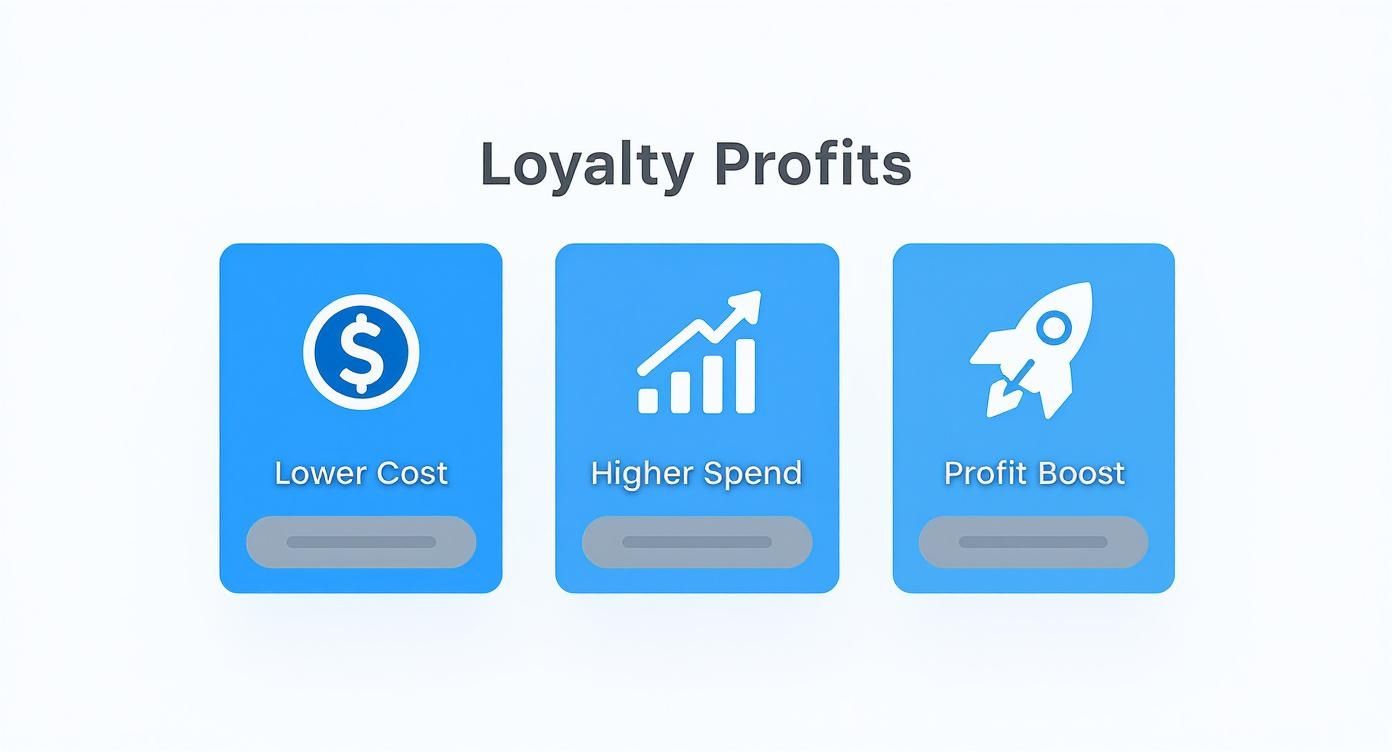
This really drives home the point that loyalty isn't just about repeat visits; it’s about building a more efficient and resilient business from the ground up.
Understanding Customer Lifetime Value
Next up is Customer Lifetime Value (CLV). This metric puts a dollar amount on a customer's entire relationship with your bar or brand. It's about looking beyond a single purchase to understand the total revenue you can expect from someone over time. Knowing your CLV helps you identify your most valuable patrons.
CLV is all about perspective. A tourist who drops $100 once is great, but a local who spends $30 every week for two years is worth over $3,000. That’s the real power of long-term loyalty.
Getting a handle on this metric is vital for making smart investments in your marketing and service. For a closer look at this important number, you can learn how to measure customer lifetime value and see how to apply it to your own business.
Keeping An Eye On Your Churn Rate
Finally, we have the Churn Rate, which is basically the opposite of retention. It measures the percentage of customers who stop visiting during a specific timeframe. You want your CRR to be high, and you want your churn rate to be as low as humanly possible.
The formula is just as simple:
- Churn Rate = (Lost Customers / Total Customers at Start of Period) x 100
So, if you started a quarter with 500 regulars and noticed 25 of them didn't return, your churn rate for that quarter would be 5%. While it's designed for software companies, a tool like this SaaS churn calculator can help you visualize how even small changes in churn can have a big impact. Tracking this number helps you spot problems early, long before they start eating into your bottom line.
Essential Retention Metrics and Their Uses
To tie this all together, these three core metrics provide a complete picture of your customer loyalty. They aren’t just abstract numbers; they are tools that can guide nearly every decision you make, from menu pricing to staff training.
| Metric | What It Measures | Simple Formula | Example Application |
|---|---|---|---|
| Customer Retention Rate (CRR) | The percentage of customers who return over a specific period. | [(End Customers - New Customers) / Start Customers] x 100 | Use this to see if a new loyalty program or special event is successfully bringing people back. |
| Customer Lifetime Value (CLV) | The total projected revenue a single customer will generate. | (Avg. Purchase Value) x (Avg. Purchase Frequency) x (Avg. Customer Lifespan) | Helps you decide how much to spend on acquiring new customers versus retaining existing ones. |
| Churn Rate | The percentage of customers who stop doing business with you. | (Lost Customers / Start Customers) x 100 | A sudden spike in churn can alert you to a problem, like a decline in service quality or a new competitor. |
By regularly tracking CRR, CLV, and Churn Rate, you move from guesswork to a data-driven approach. You'll know exactly what’s working, what isn't, and where to focus your energy to build a loyal customer base that keeps your business thriving.
Building an Unforgettable Customer Experience

Real customer retention isn't about punch cards or the occasional discount. It’s forged in moments. People don't just come back for a product; they come back to places where they feel seen, valued, and genuinely welcome. For any bar or liquor brand, the customer experience (CX) is your most powerful tool for building loyalty.
Think about it. A great Old Fashioned can be made almost anywhere, but the feeling you get when a bartender remembers your name and your drink? That's irreplaceable. This personal touch turns a simple transaction into a real connection, making your spot the spot, not just another option on the map.
Every single interaction, from the greeting at the door to the "see you next time," adds up. This isn't just fluffy stuff—it's a core business strategy that directly hits your bottom line. One amazing interaction can create a regular for life, while one bad one can send them down the street for good.
Crafting Memorable Moments
The bedrock of a great customer experience is consistency and a sharp eye for detail. It’s about training your team to do more than just pour drinks; it’s about empowering them to create an atmosphere of genuine hospitality. These small, deliberate actions are what turn a forgettable night out into one they’ll talk about.
Here are the key areas to nail down:
- Personalization: Teach your staff to remember regulars' names and their usual orders. It's a simple gesture that says, "You belong here." It makes people feel like part of the family, not just a sale.
- Atmosphere: Curate an environment that feels comfortable and inviting. This is everything from the playlist and the lighting all the way down to how clean the restrooms are. It all matters.
- Problem Resolution: A complaint is a golden opportunity. How you handle a mistake—quickly, graciously, and with a sincere apology—can build more loyalty than if everything had gone perfectly from the start.
This focus on creating positive interactions is central to customer experience enhancement, and it’s how you turn casual visitors into your biggest fans.
People today have very little patience for bad service. Every single interaction is a chance to either strengthen a relationship or lose it forever. A great experience doesn't just get them to come back; it builds the trust that true loyalty is made of.
The High Stakes of Customer Experience
The numbers don't lie—the impact of CX on keeping customers is massive. Research shows people have an extremely low tolerance for being treated poorly. As of 2025, it's estimated that 72% of customers will jump ship to a competitor after just three or fewer bad experiences.
On the flip side, customers who have great experiences stick around and spend more. A whopping 61% are willing to spend at least 5% more just to be treated better. You can dig into more of the data in this report on customer experience statistics.
At the end of the day, a superior customer experience is your most sustainable advantage. It’s what makes your bar the go-to spot and your spirit the one people ask for by name.
Actionable Strategies to Boost Retention
Knowing why customer retention matters is one thing, but actually putting that knowledge to work is what separates struggling businesses from thriving ones. The good news is, the best strategies aren't about huge budgets. They’re all about consistency, a personal touch, and making your regulars feel genuinely special.
Think of this as your playbook for turning customer loyalty from a nice idea into a core part of how you operate. The aim is simple: create a loop where great experiences lead to repeat visits, which in turn builds a stronger, more profitable business.
Launch a Loyalty Program That Works
Loyalty programs are a classic for a reason—they give people a concrete reason to choose you over the competition down the street. The secret, though, is to keep it simple. If your program is too confusing, people just won't bother.
Kick things off with something straightforward that offers immediate value. For a bar or liquor brand, a few options are a perfect fit:
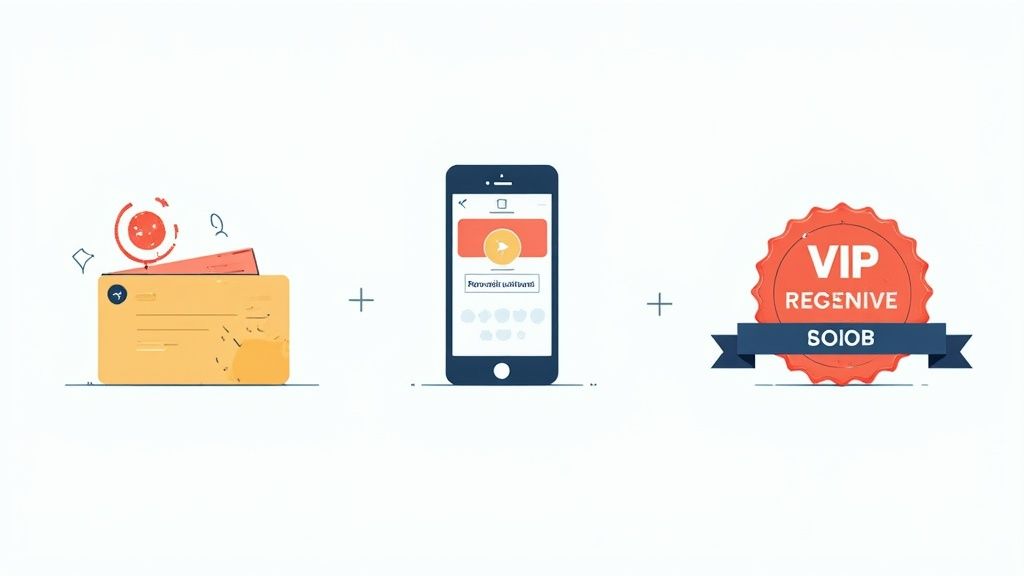
- Classic Punch Card: You can't beat the simplicity. A physical "buy nine cocktails, get the tenth free" card is easy for anyone to understand and costs next to nothing to get started.
- Digital Points System: A simple app or an integration with your POS can track customer spending. For every dollar they spend, they earn points to cash in for discounts, merch, or exclusive menu items.
- Tiered Rewards: Create a VIP club for your absolute best customers. Members could get early access to new spirit releases, a free appetizer on their birthday, or invites to members-only events.
The right program makes customers feel seen and appreciated, which goes a long way in building a real connection. If you need some inspiration, check out these powerful customer loyalty program examples to see what might work for your vibe.
Personalize Your Communication
In a market this crowded, generic marketing just becomes background noise. Personalized communication, on the other hand, shows your customers you see them as people, not just numbers on a sales report. Getting an email or phone number (with their permission, of course) is your key to building that direct line.
Use these channels to send targeted offers that feel special. A simple text like, "Hey Sarah, we just tapped your favorite seasonal IPA. First pint is on us this week!" hits a lot harder than a generic "Happy Hour 5-7 PM" blast sent to everyone.
A well-timed, personal message can be the exact nudge a customer needs to pick your bar on a Friday night. It proves you know them and value their taste, creating a sense of belonging that generic ads just can't match.
Host Memorable Events for Your Regulars
Nothing builds a community faster than a great event. Hosting special occasions just for your regulars is one of the most powerful ways to make them feel like true insiders. It shifts your bar from a place they just visit to a community they're a part of.
These events don't have to break the bank. You could host things like:
- Private Tastings: Team up with a liquor brand for a guided tasting of a new whiskey or gin before it's released to the public.
- Menu Preview Nights: Invite your top patrons to sample new cocktails or food items and give you their honest feedback before the new menu drops.
- Anniversary Parties: Celebrate another year in business with a special party dedicated to the regulars who made it possible.
These exclusive experiences create awesome memories and give your best customers great stories to tell their friends. For a deeper dive into more effective methods, this actionable guide on how to increase customer retention is packed with fantastic ideas for the hospitality industry.
Why Keeping Customers Is Tougher in Hospitality
Let's be honest: customer retention isn't the same for a bar or liquor brand as it is for a software company. The hospitality world plays by a different set of rules, and the challenges we face make keeping regulars a much trickier, but far more rewarding, game.
Think about it. There's always another bar just a block away. You've got seasonal lulls that can turn a buzzing hotspot into a ghost town overnight, not to mention the ever-changing whims of what people want to drink. One minute it's all about craft IPAs, the next it's spicy margaritas. This constant pressure is exactly why our approach to retention has to be so much smarter.
The Hard Numbers on Hospitality Loyalty
The data doesn't lie—we're fighting an uphill battle. Industries like media and professional services enjoy an average customer retention rate of 84%. Meanwhile, the hospitality, travel, and restaurant sector lags far behind at just 55%. That's a massive gap, and it's a direct result of things like shifting consumer confidence and new post-pandemic habits. If you're curious, you can dig deeper into how retention rates vary across different industries.
This glaring difference tells us one thing loud and clear.
In the world of bars and spirits, you can't just expect loyalty—you have to earn it, night after night. Our business is naturally transient, a mix of die-hard locals and one-time tourists, which means our strategy has to be just as dynamic.
Getting a handle on these unique pressures is the first real step. It's about setting goals that make sense for your bar in your town. Once you do that, you can start turning those industry-wide headaches into real opportunities to connect with people and make them want to come back.
Your Top Customer Retention Questions, Answered
Alright, we’ve covered the "what" and the "why" of customer retention. But let's be honest, putting this stuff into practice in a slammed bar or a cutthroat market is a different beast altogether.
Here are the questions that always come up when bar owners and brand managers start getting serious about keeping their customers coming back.
How Quickly Will I Actually See Results?
Look, a killer happy hour special might get someone back in the door next week, but that’s not real retention. True loyalty doesn’t happen overnight. Think of it like aging a great bourbon—it gets better with time and patience.
You should start seeing a real, measurable lift in your Customer Retention Rate and Lifetime Value within three to six months. That’s the sweet spot where consistent, positive experiences really start to cement that bond with your regulars.
Can I Actually Do This Without a Huge Budget?
Absolutely. In fact, some of the most powerful retention tactics cost next to nothing. In the hospitality world, the most valuable currency isn’t cash; it's genuine connection.
When it comes to keeping customers, consistency and a personal touch will beat a big, flashy budget almost every time. A simple, heartfelt gesture can build more lasting loyalty than an expensive ad campaign ever could.
For instance, these high-impact strategies are practically free:
- Personalized service that makes a guest feel truly seen.
- Remembering a regular's name and their go-to drink.
- Actually talking with your followers on social media.
- A simple, old-school punch card loyalty program.
Should I Focus More on Retention or Getting New Customers?
It’s the classic question, and the answer is: you need both. But they play very different roles. Think of it this way: getting new customers (acquisition) is like adding logs to the fire. Keeping existing customers (retention) is like building a better fireplace to make sure none of that heat escapes.
For most businesses, it makes way more sense to build a solid retention foundation first. Once you get really good at keeping the customers you have, you can scale up your efforts to attract new ones far more profitably.
Leave a Reply