
Picking the right email marketing platform for your bar or liquor store isn't like choosing one for a typical online business. Most reviews miss the mark because they don't get the unique pulse of the hospitality industry—things like promoting a last-minute happy hour, managing a loyalty program, or even navigating compliance rules. This guide cuts through the noise and directly compares the platforms that actually work for businesses like yours. We'll look at the tools that truly nail audience segmentation, POS integrations, and the kind of automation that gets people through your door.

Choosing Your Email Marketing Platform
Deciding on your email software is a huge deal for your bar or liquor store. The right tool isn't just for sending out a weekly newsletter; it becomes the command center for how you connect with your customers. It's what drives online orders and, more importantly, foot traffic. With so many options out there, the real trick is finding the one that fits the day-to-day reality of the beverage world.
This is more important than ever, as email continues to be a powerhouse. The number of people using email is expected to jump from 4.37 billion in 2023 to nearly 4.89 billion by 2027. That growth is pushing the email marketing industry toward a projected $14.8 billion market value in 2025, which proves that having a direct line to your customer’s inbox is an incredibly valuable asset. You can see more stats on email's financial impact at designmodo.com.
Key Considerations for Bars and Liquor Stores
Your business has specific needs that a generic, one-size-fits-all platform just can't handle. Before we get into a deep dive on features, think about what you really need day-to-day.
- Event Promotion: How quickly can you design and send a sharp-looking invite for trivia night, a wine tasting, or your weekly happy hour?
- POS Integration: Does the platform talk to your POS system, like Toast or Square? This is crucial for connecting email campaigns to real sales data and seeing what your customers actually buy.
- Automation Capabilities: Can you create "set it and forget it" campaigns? Think automated welcome emails for new loyalty members or a birthday coupon that goes out without you lifting a finger. You can learn more about how this works in our guide on what is email marketing automation.
For a bar, an email isn't just a message; it's an invitation. The best platform makes it effortless to turn a subscriber into a regular by personalizing communication around their favorite drinks, events, and specials.
To get you started, here’s a quick-glance table of our top picks. It highlights what each one does best and why it might be the right fit for your spot.
Quick Look at the Best Email Platforms for Bars
| Platform | Best For | Key Feature for Bars | Starting Price |
|---|---|---|---|
| Mailchimp | Overall Simplicity & Branding | User-friendly interface and strong brand recognition. | $13/month |
| Constant Contact | Event Management | Integrated tools for event invitations and RSVPs. | $12/month |
| Klaviyo | E-commerce & Sales Tracking | Deep integration with POS and e-commerce platforms. | $20/month |
| MailerLite | Affordability & Ease of Use | Clean design and budget-friendly plans for new businesses. | $10/month |
This table gives you a starting point. Now, let's break down each of these platforms to see which one truly has the features you need to pour more drinks and sell more bottles.
What Bars and Liquor Stores Actually Need in an Email Platform
When you're picking an email marketing tool, it's easy to get lost in endless feature lists. But for a bar or liquor store, you need to cut through the noise and focus on what actually gets people through the door. You’re not just sending emails; you’re building a local following.
Let’s break down the features that truly matter. These are the tools that will turn your subscriber list from a simple spreadsheet into your most powerful engine for growth.
Advanced Segmentation for Targeted Promotions
Your customers are not all the same, so why would you send them the same email? A generic weekly newsletter is fine, but the real magic happens when you send the right offer to the right person. This is where advanced segmentation becomes your secret weapon.
Think about it. You could send a special on a new IPA directly to your craft beer fanatics, while your wine lovers get a personal invite to a tasting event. This kind of targeting makes your marketing feel like a recommendation from a friend, not a generic ad, and that’s what drives opens, clicks, and sales. Look for a platform that lets you slice and dice your audience based on:
- Purchase History: Targeting folks who buy specific products, like bourbon or rosé.
- Visit Frequency: Rewarding your regulars or nudging customers who haven't stopped by in a while with a special offer.
- Event Attendance: Creating a special list of everyone who came to your last trivia night to build hype for the next one.
This targeted approach is the cornerstone of modern customer retention. When you personalize your communication, you're showing customers you get them, and that builds loyalty far more effectively than a blanket discount ever could. Understanding this is key, and you can dig deeper into what is customer retention to see how it directly grows your business.
Mobile-First Design Is Non-Negotiable
Let’s face it: your customers live on their phones, especially when making plans on the fly. A staggering 81% of all emails are now opened on a mobile device. If your happy hour promo looks like a jumbled mess on a smartphone, you’ve already lost.
A "mobile-first" or "mobile-responsive" design means your emails look sharp and professional on any screen, big or small. This isn’t a bonus feature; it’s absolutely essential. When that "50% off all draft beers" email hits their inbox an hour before happy hour, it has to be clear, scannable, and easy to act on right then and there.
Powerful Automation and POS Integration
Automation is your best friend. It’s what lets you run smart, timely campaigns without being chained to a computer. For a busy bar or store owner, this means setting up automated "journeys" that work for you around the clock.
For example, you can set up a welcome series for new loyalty members or an automatic birthday email with a coupon for a free drink. The really great platforms will even let you create a re-engagement campaign that automatically sends a "we miss you" offer to customers who haven't visited in over a month.
But to make this all work, your email platform needs to talk to your Point of Sale (POS) system, like Toast or Square. This integration is the missing link. It feeds real sales data into your marketing, powering that advanced segmentation we talked about and, most importantly, proving that your email campaigns are actually making you money. We’ll get into which platforms do this best later in the comparison.
Detailed Comparison of Top Email Marketing Platforms
Alright, we've covered the must-have features for any bar or liquor store's email marketing. Now it's time to put the big players—Mailchimp, Constant Contact, and Klaviyo—head-to-head in a direct email marketing platforms comparison.
Each of these platforms brings something different to the table. The "best" one really depends on what you're trying to accomplish, whether that's packing your bar for a special event or boosting online bottle sales. We're going to look at them through the lens of a busy bar manager: how easy are they to use, how smart is their automation, and do they play nicely with essential tools like your POS system?
This isn't about finding a single winner. It's about finding the right tool for your job.
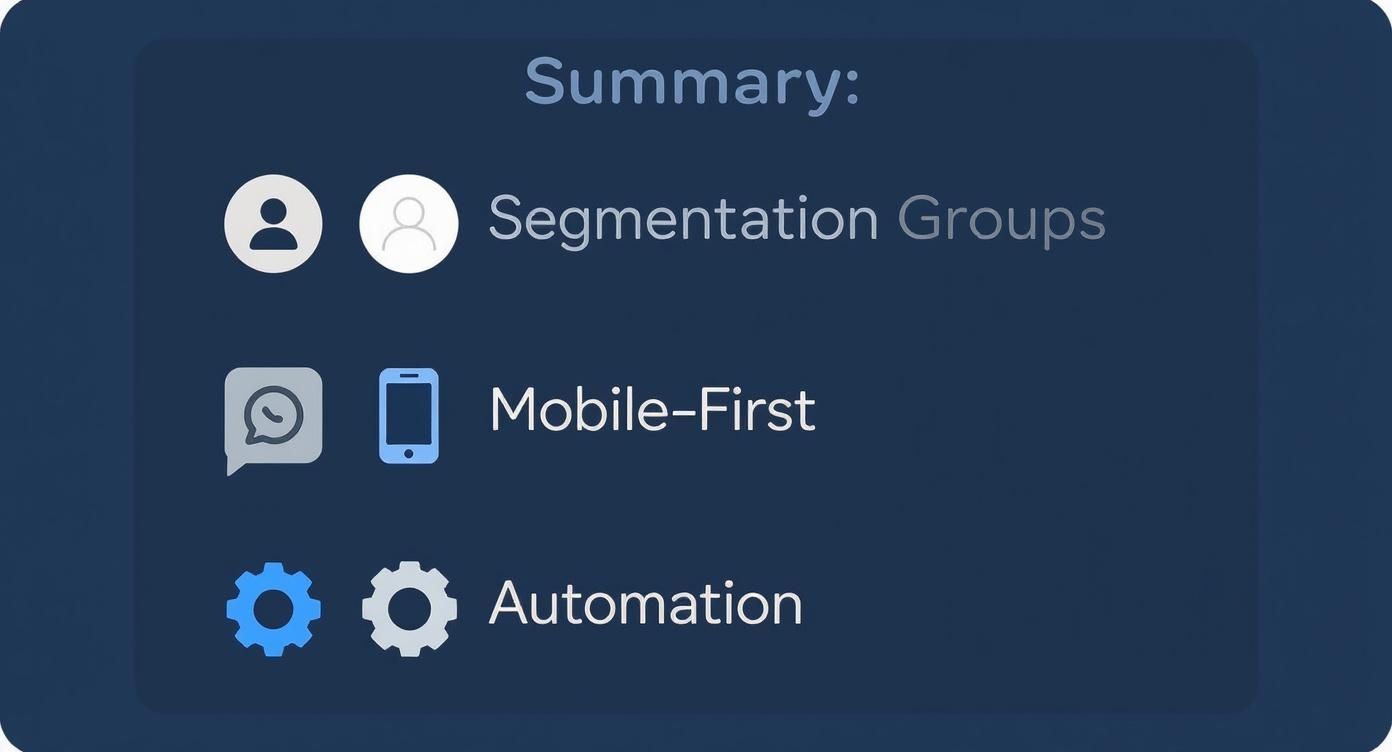
As you can see, a winning strategy always comes back to three things: knowing your audience (segmentation), meeting them where they are (mobile-first), and using smart automation to keep them coming back.
Mailchimp: The All-Around Contender
Mailchimp is probably the first name that pops into your head, and for good reason. Its greatest asset is its user-friendly interface, which makes it incredibly approachable for small businesses just getting started. If you're a bar owner who needs to quickly design a great-looking email for a weekend special, Mailchimp is tough to beat.
The drag-and-drop editor is as simple as it gets, letting you build professional emails without needing a graphic designer on speed dial. It also comes loaded with templates perfect for event announcements, happy hour reminders, or highlighting a new craft beer on tap.
The catch? Mailchimp can feel a bit basic when your marketing gets more serious about driving sales. While it has some e-commerce integrations, it just doesn't have the deep, revenue-focused analytics or complex automation workflows that more specialized platforms offer. It’s a fantastic tool for sending beautiful newsletters and building your brand, but you might hit a ceiling as your strategy grows. For a broader look at the landscape, this guide on the 12 Best Email Newsletter Platforms of 2025 is a great resource.
Key Takeaway for Mailchimp: This is your platform if the main goal is sending beautiful, straightforward newsletters and easily managing your contact list. It’s perfect for businesses focused on brand-building and simple communication over complex sales funnels.
Constant Contact: The Event Promotion Specialist
Constant Contact has smartly focused on businesses that run on events. For bars that depend on trivia nights, live music, and tasting events to bring people in, this platform is a game-changer. Its standout feature is the built-in event management toolkit.
This isn't just about sending an invitation. You can handle RSVPs, sell tickets, and see who’s coming, all from one place. Think about planning a ticketed New Year's Eve party or a special wine-tasting dinner—this integrated system cuts out a ton of logistical headaches.
The trade-off is that its automation and segmentation aren't nearly as robust as its competitors. It’s great for basic autoresponders like a welcome email, but building out sophisticated customer journeys based on what they buy or how often they visit is much more difficult. Constant Contact is built to get people to a specific event on a specific date, not necessarily for nurturing long-term relationships with automated, data-driven campaigns.
Klaviyo: The E-commerce Powerhouse
If your liquor store has a strong online shop, or your bar sells a lot of merchandise and gift cards online, then Klaviyo is in a class of its own. It was designed from the ground up for one purpose: driving revenue. Its secret sauce is its incredibly deep integration with e-commerce platforms like Shopify and WooCommerce.
Klaviyo vacuums up customer data—what they looked at, what they bought, when they bought it—and lets you use it for some seriously targeted marketing. You can set up automated workflows for things like:
- Abandoned Cart Reminders: Sending a timely nudge to customers who left items in their online cart.
- Post-Purchase Follow-ups: Automatically sending a thank-you note with a few related product suggestions.
- Predictive Analytics: Pinpointing customers who are most likely to buy again and hitting them with a targeted offer.
This level of detail is incredibly powerful for boosting online sales. The downside? All that power comes with a much steeper learning curve and a higher price. For a neighborhood bar that's all about getting people in the door, Klaviyo is probably overkill. It truly shines when you have a direct online sales channel to optimize.
Feature-by-Feature Platform Comparison Matrix
To really put things in perspective, this matrix breaks down how each platform performs on the features that matter most to a bar or liquor business. This head-to-head view makes it easy to see the strengths and weaknesses in a direct email marketing platforms comparison.
| Feature | Mailchimp | Constant Contact | Klaviyo | Niche Platform |
|---|---|---|---|---|
| Ease of Use | Excellent (Very intuitive for beginners) | Good (Easy to navigate, especially for events) | Moderate (Steeper learning curve due to advanced features) | Varies (Often very simple) |
| Event Marketing | Basic (Standard campaigns) | Excellent (Built-in RSVP and ticket tools) | Good (Relies on integrations) | Limited (Usually not a focus) |
| POS/E-commerce Integration | Good (Integrates with major platforms) | Fair (Basic integrations available) | Excellent (Deep, revenue-focused data sync) | Good (Often targets specific POS like Toast) |
| Automation Power | Good (Solid for basic welcome/drip series) | Basic (Best for simple autoresponders) | Excellent (Complex, behavior-driven workflows) | Basic to Moderate |
| Segmentation | Good (Tagging and basic segments) | Fair (List-based segmentation) | Excellent (Hyper-targeted, dynamic segments) | Good (Often uses POS data) |
| Best For | Brand Building & Newsletters | Event-Driven Bars & Venues | E-commerce Liquor Stores | Loyalty & Foot Traffic |
Ultimately, choosing the right platform comes down to your main goal. If you want to pack the house for trivia night, Constant Contact is built for that. If you're focused on selling more cases of that special bourbon online, Klaviyo is the undisputed champ. And if you just need a solid, easy-to-use tool for all-around communication, Mailchimp is a reliable place to start.
Putting Email Platforms to the Test in Real Scenarios
Feature lists are one thing, but how do these platforms actually hold up when you’re in the middle of a busy week? Let's take this email marketing platforms comparison out of the theoretical and into the real world. I’ll walk you through three common situations any bar or liquor store owner faces.
We're going to see how different platforms handle the pressure of promoting a recurring event, launching a quick sale, and automating a critical loyalty campaign. This is where you really start to see the small but significant differences in how they work, who you can target, and how easy they are to use day-to-day.
Scenario 1: Promoting a Weekly Trivia Night
Your goal is simple: get people in their seats every Tuesday for trivia. This means you need a fast, repeatable way to announce the event, send reminders, and maybe even drop hints about the grand prize. Let's see how Constant Contact and Mailchimp tackle this common task.
Constant Contact's Approach
This is exactly what Constant Contact was built for. Its event management tools are baked right in, which makes a huge difference.
- Event Creation: First, you create a single "Trivia Night" event right inside the platform.
- Invitation: You then use a dedicated event template to send the initial invite, complete with RSVP buttons.
- Automation: From there, the platform automatically sends reminders to everyone who RSVP'd. You can even set it to send a follow-up "thanks for coming" email the next day.
The whole process lives under one roof, which is a lifesaver for recurring events. You just clone last week's campaign, tweak the details, and hit send. It's incredibly efficient.
Mailchimp's Approach
With Mailchimp, you'll find the process is a bit more manual, but you gain more control over the look and feel.
- Campaign Building: You’d start by creating a beautiful, custom email using their best-in-class drag-and-drop editor.
- RSVP Handling: This is the catch. You have to link out to an external tool like Eventbrite or a simple Google Form to handle RSVPs since there's no native event management.
- Segmentation for Reminders: To send reminders, you have to manually create a segment of everyone who clicked your RSVP link. It’s an extra, and slightly clunky, step.
Verdict: For pure event promotion efficiency, Constant Contact is the clear winner. If your bar relies on a packed event calendar, its integrated system will save you a ton of time. Mailchimp gets the job done, but it definitely involves more manual work and juggling other tools.
Scenario 2: Launching a Flash Sale on Wine
Okay, imagine this: you’ve got too much of a great Cabernet and want to run a weekend "25% off" flash sale through your online store. The goal here is immediate e-commerce revenue. We'll pit the e-commerce powerhouse, Klaviyo, against a solid all-rounder like MailerLite.
Klaviyo's Workflow
Klaviyo was born for e-commerce, and it shows.
- Hyper-Targeted Segmentation: You can instantly pull a list of every single customer who has ever bought red wine from you. Want to get even more specific? You can narrow it down to those who have spent over a certain amount, letting you target your most valuable wine lovers first.
- Dynamic Content: The email itself can dynamically pull product images, descriptions, and prices straight from your Shopify or WooCommerce store. No copy-pasting required.
- Revenue-Focused Reporting: After you send it, Klaviyo tells you exactly how much money that one email generated, which customers bought, and your precise ROI.
This deep integration connects your marketing directly to your sales. It’s a game-changer for understanding what actually works.
MailerLite's Workflow
MailerLite gives you a simple and affordable way to get the word out. You can build a clean, attractive email promoting the sale and link out to your product page. It works. However, it just doesn't have the data-driven punch of Klaviyo.
You can segment customers based on general groups you’ve already created, but you can’t automatically target them based on what they’ve bought in the past without a lot of manual list management. Your reports will show opens and clicks, but you won't get that direct, dollar-for-dollar revenue attribution without comparing spreadsheets from your sales platform.
Verdict: For any bar or liquor store that's serious about online sales, Klaviyo is in a league of its own. The ability to use purchase data for targeting and reporting is a massive advantage. MailerLite is a fantastic, budget-friendly choice for simple announcements but doesn't have the e-commerce muscle.
Scenario 3: Automating Birthday Rewards
Sending customers a special offer on their birthday is a classic loyalty play. This is something you want to set up once and let it run forever in the background.
Both ActiveCampaign and Mailchimp have strong automation builders that are perfect for this. The real difference is in the "smarts" you can build into the process.
- In Mailchimp: You can create a simple, effective journey. When a subscriber's birthday field matches today's date, it triggers a "Happy Birthday!" email with a static coupon code. It's straightforward and gets the job done.
- In ActiveCampaign: Here's where you can get much more sophisticated. For example: "On a subscriber's birthday, send them an offer. If they open it but don't click within three days, then send a reminder. If they are also tagged as a 'VIP Customer,' then send them an even better offer."
That ability to use "if/then" logic and layer multiple conditions makes ActiveCampaign's automation far more powerful. You can create truly personalized experiences that go a long way in keeping your best customers coming back.
Analyzing Pricing and Long-Term Value
It’s easy to get tunnel vision and just pick the platform with the lowest advertised price. I’ve seen countless business owners make that mistake. The problem is, that initial sticker price almost never tells you the whole story. To really figure out what you'll be spending, you need to look at the total cost over time and see which platform genuinely supports your bar or liquor store’s growth.
Getting a handle on the true email marketing costs is about more than just the monthly bill. It’s about understanding the long-term value. Let's dig into the common pricing structures and expose the hidden fees that can catch you by surprise.
Decoding Pricing Models
Most email platforms operate on one of two main models. Each has its own rhythm, and what works for one bar might be a terrible fit for another, depending entirely on your size and how often you're sending emails.
- Subscriber-Based Tiers: This is what you'll see most often. You pay a set monthly fee based on how many contacts you have (e.g., up to 2,500 subscribers). It's predictable, which is great for budgeting, but it can get pricey fast as your customer list grows.
- Pay-As-You-Go/Volume-Based: This model is all about flexibility. You’re charged based on the number of emails you actually send. For a bar that only does heavy promotions around big holidays like New Year's or St. Patrick's Day, this can be a lifesaver.
For a small but growing business, a subscriber-based plan usually offers a solid, predictable starting point. Just be sure to keep a close eye on the price jumps between tiers as you scale up.
The most affordable plan today might become the most expensive one six months from now. Always look at the pricing for the next two tiers above your current needs to anticipate future costs and avoid being priced out of a platform you love.
Thinking ahead like this is key to managing your budget and making sure the platform scales with you, not against you.
Uncovering Potential Hidden Costs
That monthly subscription fee is just the starting line. A lot of platforms have extra charges tucked away in the fine print that can seriously inflate your bill if you're not paying attention.
Keep an eye out for these common "gotchas":
- Overage Fees: Going over your subscriber or sending limit can trigger some pretty steep penalties. Some platforms are more forgiving than others, but it’s a classic way costs creep up.
- Charges for Key Features: That killer automation builder or POS integration you really need? It might only be available on a higher-priced plan, effectively doubling what you thought you'd pay.
- Contact Duplication: Some platforms, famously Mailchimp, charge for every subscriber on every list. If the same customer is on your "Trivia Night" list and your "Craft Beer Lovers" list, you could be paying for them twice.
These little details can completely change the math on your total investment. A platform that looks cheaper on the surface can quickly become more expensive once you add up the cost of the features you actually need. Our guide on how to measure marketing ROI can help you connect these costs to real business results.
Calculating Your True Monthly Investment
Let’s run the numbers for a couple of real-world scenarios you might face.
Scenario A: Small Bar with 2,000 Subscribers
Imagine a neighborhood bar with a steady list of 2,000 regulars. They send out a weekly newsletter and event announcements.
- Platform 1 (Subscriber-Based): The plan for up to 2,500 subscribers costs $45/month. Simple, predictable, no surprises.
- Platform 2 (Volume-Based): Sending 8,000 emails a month (4 campaigns x 2,000 contacts) might cost around $30/month. If the list size isn't growing rapidly, this is clearly the more cost-effective choice.
Scenario B: Growing Liquor Store with 10,000 Subscribers
Now think about an e-commerce liquor store with 10,000 contacts that needs advanced automation for abandoned cart reminders and customer segmentation.
- Platform 1 (All-in-One): Their $150/month plan includes every feature needed, all bundled together.
- Platform 2 (Cheaper Base): This one starts at a tempting $90/month, but the e-commerce automation you need is a $50/month add-on. The true cost is actually $140/month—almost identical to the first option, but with features frustratingly split across different packages.
By running these simple calculations, you can cut through the marketing fluff and see the real financial picture. It’s the only way to choose a partner that will help you grow without draining your bank account.
So, How Do You Actually Choose?
Alright, we've thrown a lot of information at you. Sifting through all the features and pricing tiers can make your head spin, but picking the right email marketing platform really boils down to what your specific bar or liquor store needs to thrive. There’s no magic bullet—just the right tool for the job you need to get done.
Think about it this way: a local pub that packs the house with weekly trivia nights and live bands needs something straightforward. You need to get the word out, fast. A platform like Constant Contact is perfect here, with its easy-to-use event tools that let you promote your lineup without getting bogged down in complicated tech. Your goal is simple: get regulars and new faces through the door.
Now, picture a liquor store that's also building an online shop. Your game is totally different. You need a workhorse like Klaviyo that connects directly to your sales system. This is where you get a serious return on your investment by automatically sending abandoned cart reminders or targeting customers based on what they’ve bought before. That’s how you turn website visitors into repeat online buyers.
Your Final Gut-Check Questions
To feel truly confident in your choice, take a minute and be brutally honest with yourself. Run through this quick checklist:
- What’s my #1 goal? Am I trying to pack the bar for events, or am I focused on driving online sales?
- How much time do I really have? Can I realistically spend a few hours a week on this, or do I need something I can set up in minutes?
- Am I a tech whiz or a tech novice? Do I want a simple, drag-and-drop experience, or am I comfortable digging into more advanced automation features?
- What's my budget today and tomorrow? Does the cost fit my current cash flow, and will it still make sense when my email list doubles in size next year?
At the end of the day, the best platform is the one you’ll consistently use. Picking a tool that fits your reality means you won't be paying for a bunch of fancy features you never touch or fighting with a system that's too confusing for you and your team.
Frequently Asked Questions
Even after a deep dive into different platforms, you probably still have a few lingering questions. Let's tackle some of the most common ones we hear from bar and liquor store owners about the practical, day-to-day challenges of email marketing.
Which Platforms Play Nicest With My POS System?
Connecting your email marketing to your sales data is where the magic really happens. For bars and liquor stores, this is non-negotiable. The platforms with the strongest, most seamless integrations are usually the ones built with e-commerce and retail in mind.
Klaviyo is a standout here, offering incredibly deep, native integrations with major POS systems like Toast and Square. This allows you to get super specific with your targeting. For instance, you could create a campaign that goes only to customers who have purchased a specific IPA in the last month.
While platforms like Mailchimp have solid integrations, you might find they don't pull in the same level of detailed purchase data without some extra work. Before you commit to any platform, do yourself a favor and check its app marketplace to make sure there’s a direct, well-supported connection to your exact POS.
Key Insight: A slick POS integration is the key to proving your email marketing is actually working. It stops being just a list of contacts and becomes a powerful sales engine, directly tying your email campaigns to real revenue.
How Do I Handle Age Verification for My Email List?
This is a big one. For any business selling alcohol, getting age verification right is a critical compliance step. The most common and straightforward way to handle this is with a pop-up or a dedicated landing page form that asks new subscribers to confirm their age before they can join your list.
Here's how to do it right:
- Use a Mandatory Checkbox: Add a field to your signup form that says something like, "I certify I am 21 years of age or older." This absolutely must be a required field.
- Set Clear Expectations: It's also a good practice to include a brief disclaimer in your email footer, reminding everyone that your content is only for an audience of legal drinking age.
The good news is that most email platforms make it pretty easy to add custom fields and required checkboxes to your forms, so setting this up is usually a breeze.
This article originally appeared on SharpeTools.com as part of the Bar Marketing 101 series.